John William Will 1883 - 1917
+ Sgt Wm
Denison
Family history
Born on 9 January 1883 in Leeds, Jack's antecedents have been traced back to the early
18th century. His parents were Johann Georg Will and Anna Katherina Fex of Langenhain, a rural district to the west
of Frankfurt. Married in 1873, Johann and Anna probably had Katerina (aka Kate or Catherine) there in 1873.
It is not known why they emigrated to Bradford later that year.
Johann found employment as a farm labourer.
Edward was born in Bradford in early 1874, then Henry in 1875.
There was then a 6 year gap to Laurence, born in Leeds in 1881. Sadly, he only lived for 2 months.
After John William’s birth in 1883, the family moved back to Bradford,
where they lived in streets off Otley Road, near the Canal Road junction.
This, the Undercliffe area, was close to the stuff warehouses of Little Germany, where Jack is
thought to have worked as a roller.
By 1908, he was living in Ripon Street in Undercliffe and working as a draper.
He married Elma Bateson at St Augustine’s Parish Church on 15 April that year.
By 1911 he was a wholesale draper.
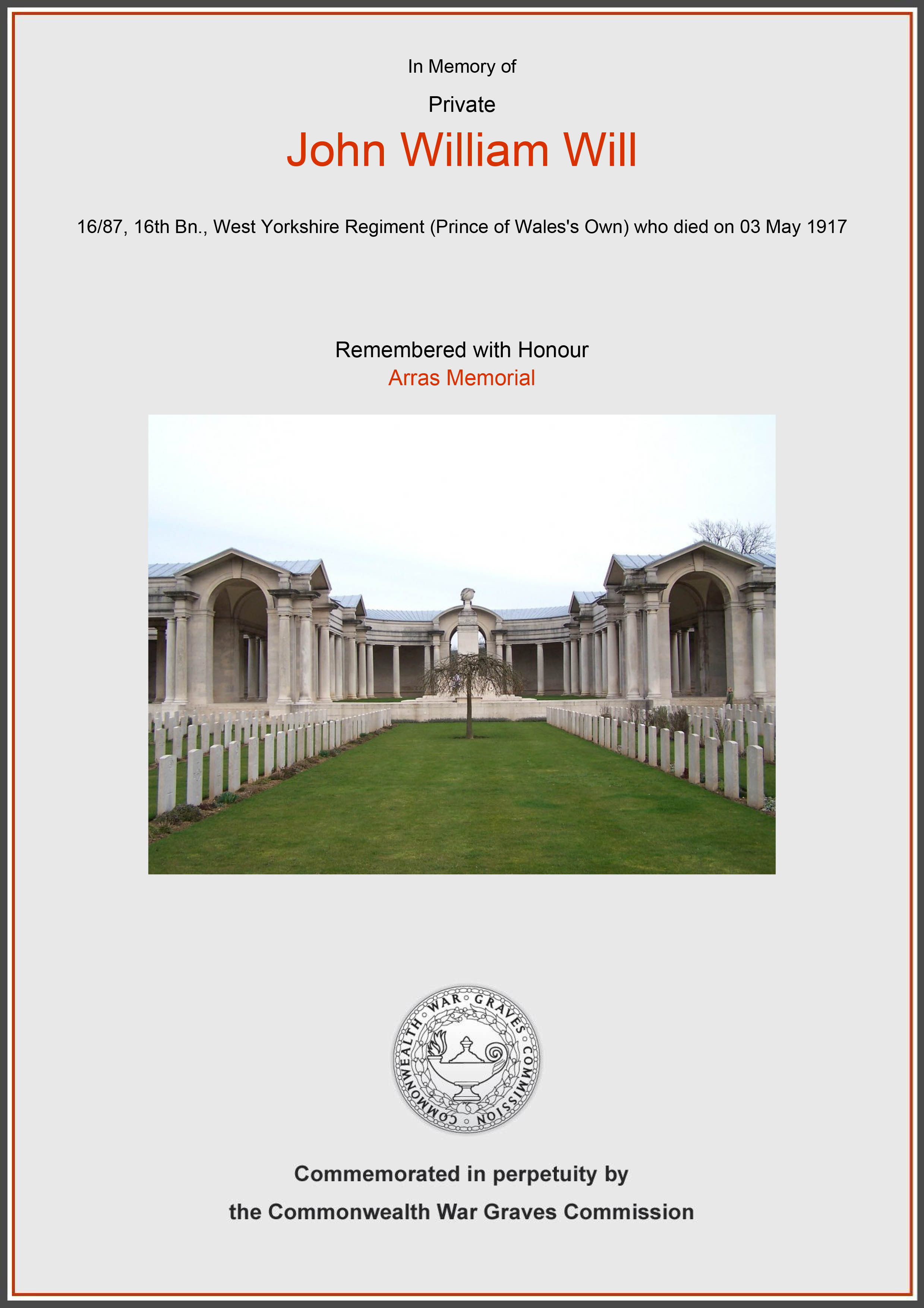
He died on 3 May 1917 at Gavrelle, France.
John William Will
At the beginning of the War, he was, according to the family, a Recruiting Agent
who gave talks to audiences of young men.
Recruiting Agents were not serving members of the armed forces, but retired soldiers,
pensioners and ordinary civilians. It is likely that they were volunteers, though by 1915, when the initial
enthusiasm for war had worn off, those who worked in recruitment offices, and perhaps in lecture halls, could
claim a financial reward for every recruit they processed.
Jack Will must have delivered some of the 20,000 speeches that were promoted by the
Parliamentary Recruiting Committee, which was established in 1914 to persuade men to enlist and create a huge
volunteer army to fight a war that might, as Kitchener feared, last many years.
He would also have been involved in the group recruitment drive
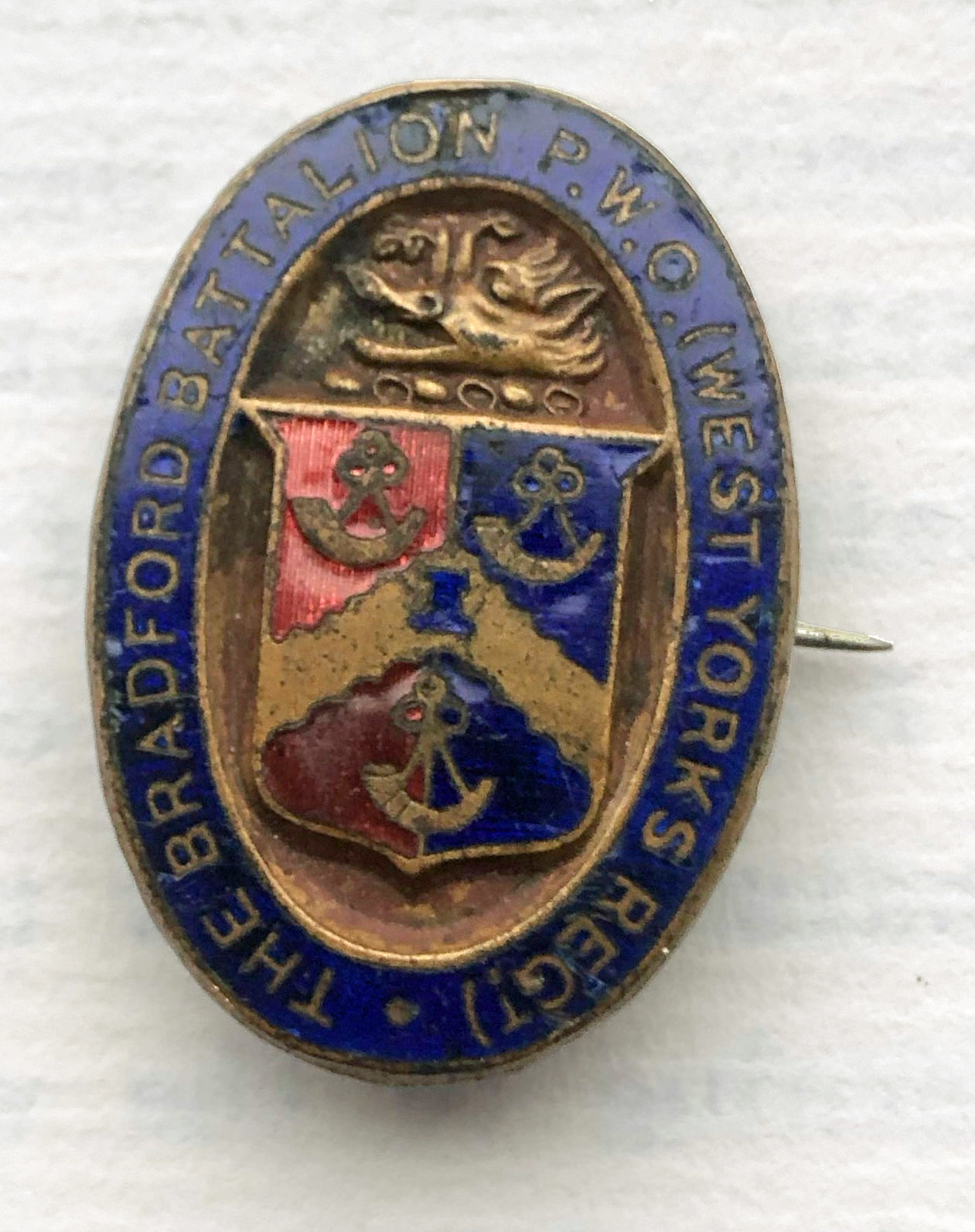
that resulted in the creation of Bradford’s first Pals Battalion, which would later become known as the 16th (Service)
Battalion, (1st Bradford), Prince of Wales's Own, West Yorkshire Regiment and come under the orders of the 93rd Brigade,
31st Division. It was a volunteer unit that was sanctioned by the government, but paid for out of donations collected in Bradford.
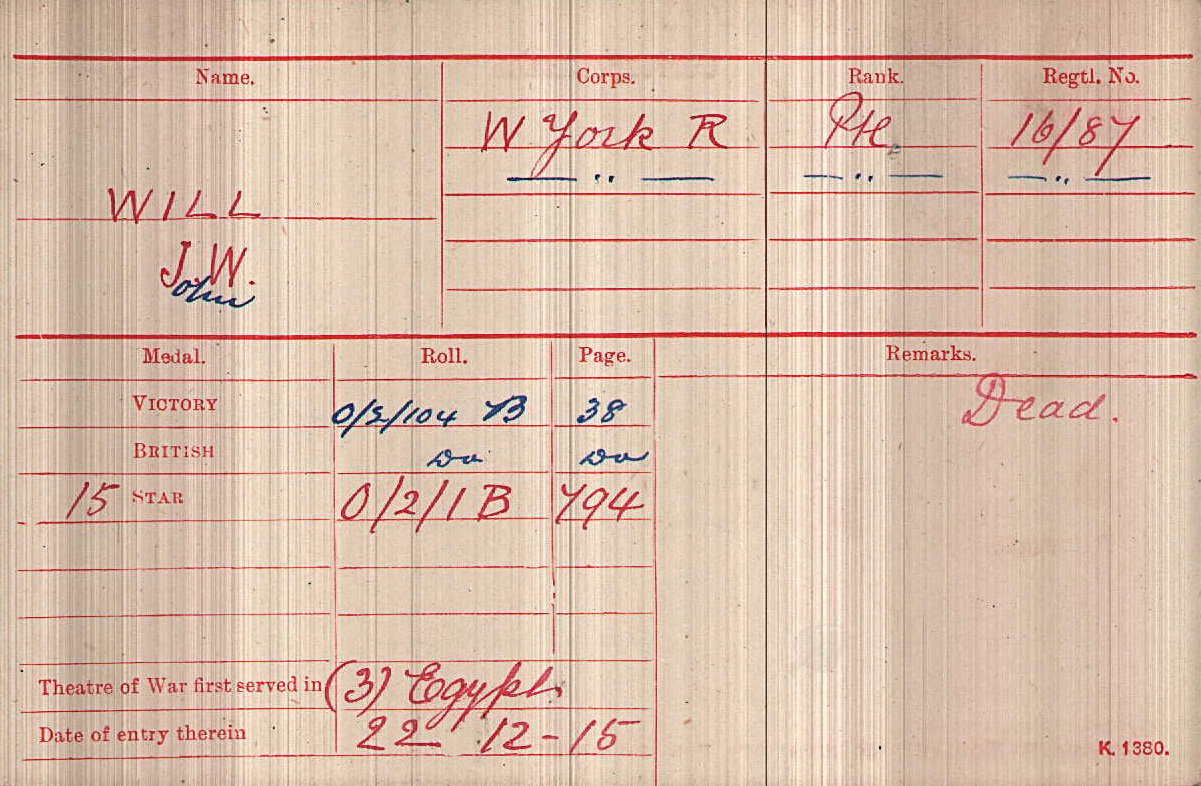
Private John Will’s army number was 16/87, an indication, perhaps, that he was
the 87th recruit to the 16th Battalion.
There is a family story that although Jack’s job gave him exemption from war service,
he decided he could not ask men to volunteer without doing so himself.
Perhaps this meant that his work as a Recruiting Agent job gave him a moral exemption from military service,
one that was accepted by the community because it was seen to be an essential part of the war effort.
There was, of course, no legal requirement to enlist – conscription did not come into force until mid-1916.
There is another family story that he enlisted to get away from his wife, Elma.
The story goes that she refused to have any more children; it could be that by 1914 their relationship was in difficulties.
Although it is not known exactly when Jack enlisted (his army record has been lost),
the Pals Battalion began recruiting in September 1914 and underwent training in Skipton and Ripon, then Fovant
(Salisbury) in 1915. The battalion travelled to Liverpool on 6 December that year and embarked on the Empress of
Britain, a former transatlantic liner requisitioned and converted as a troopship.
Jack was not impressed with the accommodation, writing that it had “a low deck, terribly
stuffy..” and “..it was not till we prepared to settle down that we realised the bad conditions we were to sail under.“
He would have been even less impressed had he known how accident prone the Empress was: in 1912,
just 2 weeks after the Titanic, it had survived an encounter with an iceberg and, 3 months later in thick fog, it had
rammed and sunk a collier called Helvetia on the St Lawrence River. Then, 8 days into the voyage from Liverpool,
on the night of 14 December 1915, while navigating without lights (mandatory in wartime) she hit a French troopship off Malta,
cutting it in two. The vessel, the SS Djurjura, sank and two stokers were killed.
The Empress of Britain made it to Alexandria on 21 December, when the Pals discovered
that their destination was Egypt. They spent a pleasant month sightseeing, before marching to Kantara,
at the Mediterranean end of the Suez Canal, and then to a desert outpost 7 miles to the east called Point or Hill 70.
The battalion’s job was to defend the caravan routes between Egypt and the countries of the Levant. Living under canvas
in the desert would have been uncomfortable: heat, dust and flies. Water was severely rationed: a gallon of water per man per day.
Food was also restricted: a tin of condensed milk to share among 16 men. The monotonous diet was relieved a little when the Pals
made friends with some Mysore Lancers, who were camped nearby: the Indians were always ready to exchange a bowl of curry for a pack
of cigarettes. Writing to Elma, Jack described them as: “fine, reliable and honourable fighting men who are totally loyal to the
British crown.”
The battalion’s chief activity, after digging trenches and visiting neighbours, was stopping the locals from stealing their kit.
Photos & images



The battalion shipped to Marseille on 29 February 1916 onboard the SS Minneapolis
(on her return voyage to Alexandria on 23 March 1916, she was torpedoed off Malta and later sank), then went
by train to Pont Remy, a station on the River Somme, arriving on 9 March. Later, they marched to billets at Bus-les-Artois.
The whole brigade moved to Gezaincourt, near Doullens, on June 19th 1916. Here they began a special
course of training to prepare them for the coming Somme offensive. They practised going over the top, leaving trenches using
assault ladders and the principle of attacking in wave formations etc.
While at Gezaincourt, Major G. S. Guyon of the Royal Fusiliers arrived to command the 16th Battalion.
The battalion first engaged the enemy at the Battle of the Somme on 1 July 1916.
It did not go well for the British. Churchill later wrote that the German positions there were
“the strongest and most perfectly defended position in the world.”
The death toll was terrible.
It is estimated that 515 out of 699 men and officers in the battalion were killed or wounded.
It is not known if Jack Will was involved in the action. Since he survived, he may have been held in reserve.
Back home, it is interesting to note, the Bradford Daily Telegraph of 7 July reported “very few deaths”,
reflecting War Office propaganda.
As long lists of casualties began to appear, the paper (on 18 July) noted that “the noblest youth of the country walked open-eyed
to their deaths on the ridges of the Somme.”
Post-Somme diary
The remnants of the 16th Battalion marched north to Lestram and then to Les Lobes.
In early September 1916 the battalion was in the right sub-section in the Neuve Chapelle section of trenches.
On 27 September the men went into front line trenches in the Neuve Chappelle area,
and were subjected to a bombardment and also suffered a raid by German troops. 6 were killed and 42 wounded of whom 4 died later.
On 3 October 1916, the 31st Division was taken out of the line and moved to the
Bethune area. After a brief respite in billets in the town, the 16th Battalion marched to La Miquellerie.
On 7 October, the 16th Battalion marched on to billets in Famechon.
On 30 October, the 16th Battalion proceeded to billets in Thievres.
November 13 1916 marked the beginning of the British offensive on both banks of the
River Ancre, a tributary of the Somme.
On 31 December 1916, the 16th Battalion moved to Coigneux to rest.
On the evening of 26 February 1917, the 16th Battalion received orders to probe German defences
at Rossignol Wood (between Gommecourt and Puisieux). Unfortunately, poor intelligence meant the men were unaware of an
enemy gun emplacement in the Wood.
They were cut down, losing 76 officers and men with 150 missing.
The 16th Battalion were relieved by the 13th Battalion (York and Lancaster Regiment) and proceeded to a
camp near Coigneux on the Courcellers Road.
At the end of March 1917, the entire 93rd Brigade moved back to the Bethune area.
On 28 April the 93rd Division went back north to the Scarpe valley and relieved the
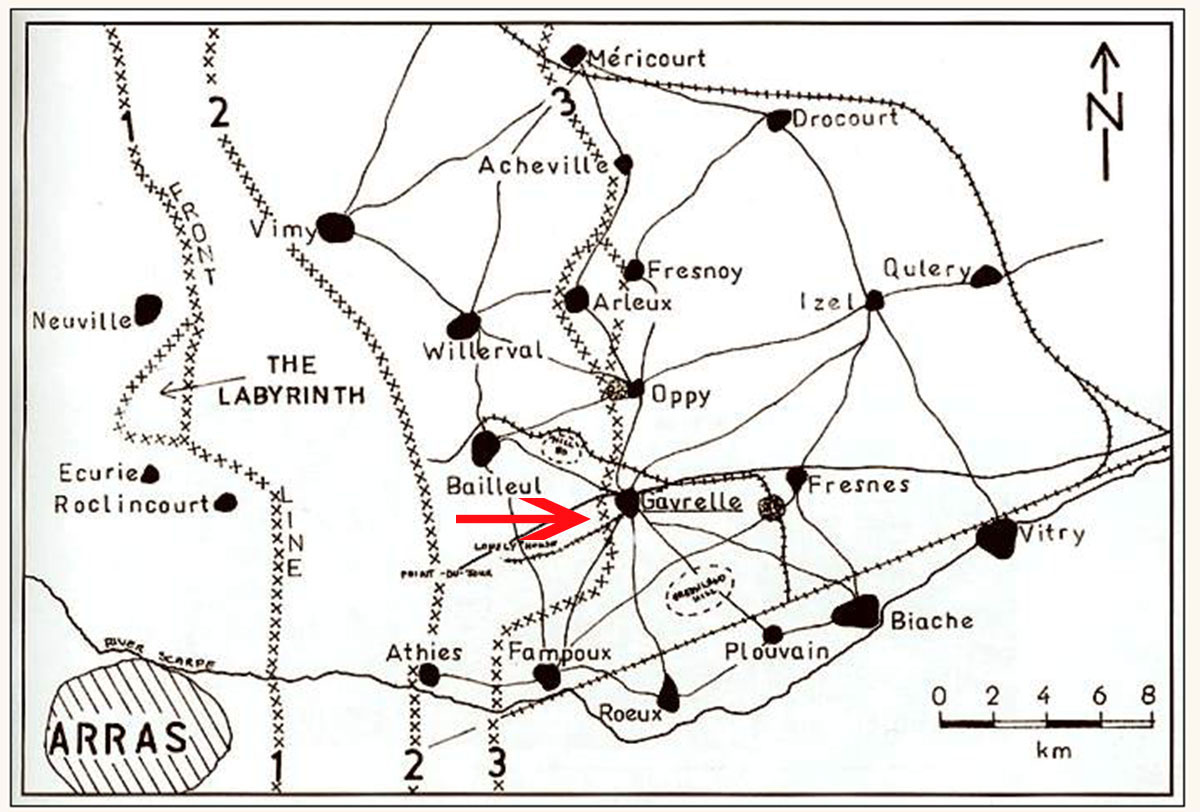
63rd Naval Brigade in the Gavrellle sector, about 4 miles ENE of Arras.
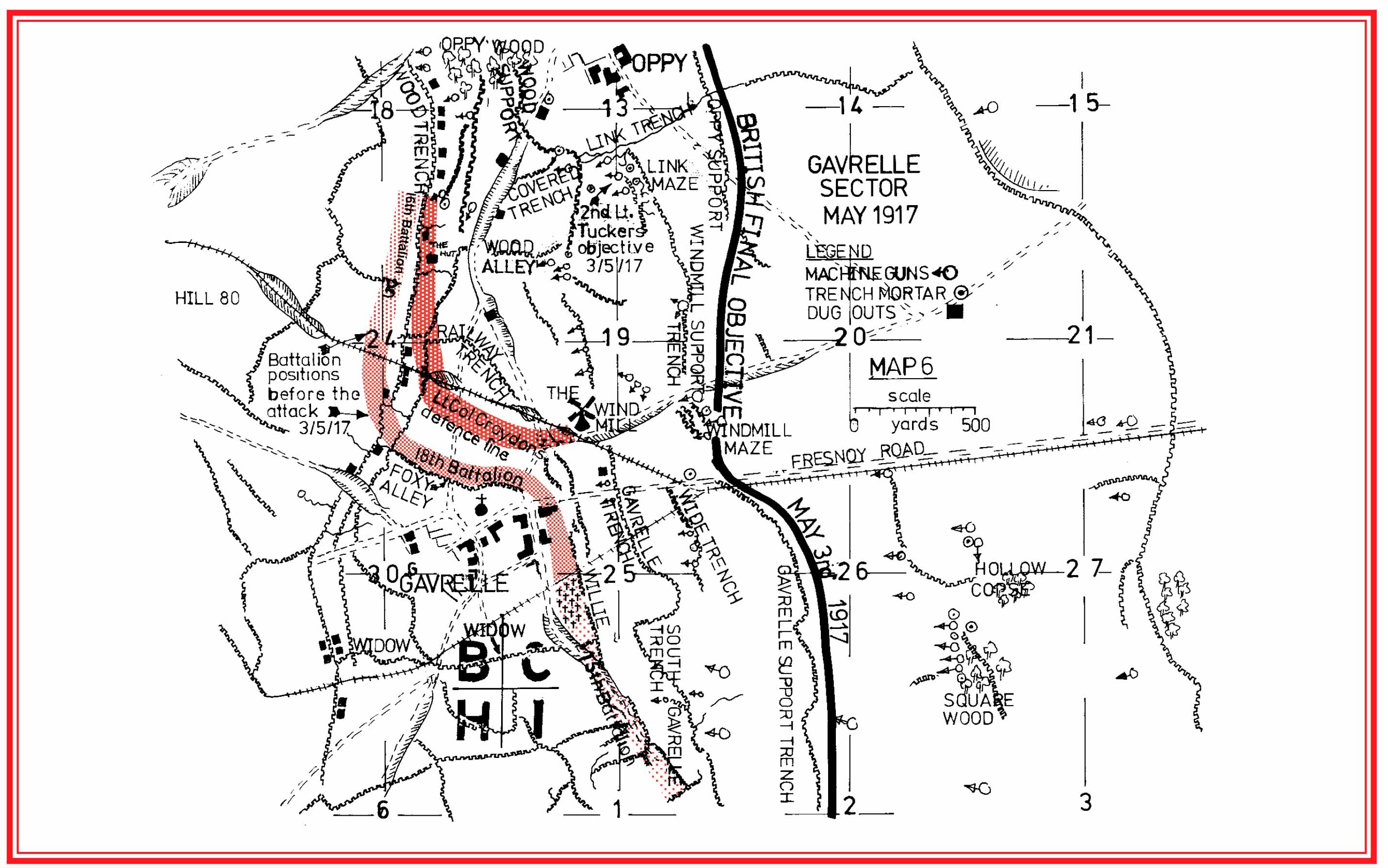
The 16th Battalion was positioned in trenches between Gavrelle and Oppy, roughly where an electricity sub-station
stands today. It was commanded by Lt Col AC Croydon.
Jack Will would have been in one of four Companies of platoons:
'A', 'B', 'C' or 'D'.
This
photograph
taken in Bradford in 1914 shows him in the 3rd row with other Pals in 'D' Company.
3rd Battle of the Scarpe
The 3rd Battle of the Scarpe began early on the morning of 3 May 1917.
See Map:
Gavrelle Sector
At 3:45 the battalion advanced, under cover of an artillery barrage, on enemy trenches between
Windmill and Link Maze (just south of Oppy). Unfortunately, no-man’s land was bathed in bright moonlight, making the German gunners’ aim easier.
At 3:49 an intense enemy barrage was directed at the entire front line, accompanied by heavy machine gun and rifle fire.
This artillery barrage would go on for another 8 hours.
'C' and 'D' Companies were in the first attack waves, passing through the enemy wire without difficulty.
'D' Company got to the first enemy trench, well ahead of 'C' Company, at 4am.
The men took prisoners and began to consolidate the trench.
The other Companies followed, a little behind schedule.
At 5am, 'D' Company, commanded by Capt Parker, saw 100 enemy soldiers approaching. Thinking they were surrendering, the Germans were waved on.
But they opened fire; the British retaliated with Lewis guns and rifles; many of the enemy were killed; the remainder
fell back in disorder.
By 7:30 the battalion, led by 'D' Company, was consolidating its position
in the newly won trenches.
5 minutes later, though, the Germans mounted an effective counter attack,
coming in waves down the ridge: "we had many casualties".
Amid heavy losses, the order was given to withdraw.
Most of 'A' Company’s casualties were suffered during the withdrawal.
Nothing is known about how Jack Will met his death. Following common practice, all the fatalities
mentioned by name in the Battalion Diary were officers.
At 15:15, Brigade command ordered that a composite battalion be formed of the remnants
of the 16th and 18th Battalions, under the command of Croydon.
He had at least achieved the objective of getting his men back to their original positions.
The capture of Oppy Wood was not achieved until 28 June 1917.
The Third Battle of the Scarpe resulted in the British Army suffering nearly 6,000 men killed for little gain.
5,000 of them were classed as Missing: their bodies were probably never recovered from the battlefield.
In addition to John William Will, the 16th Battalion lost 17 men listed as Killed in Action,
with 176 listed as Missing.
Total casualties, including wounded, were: 11 officers and 303 men.
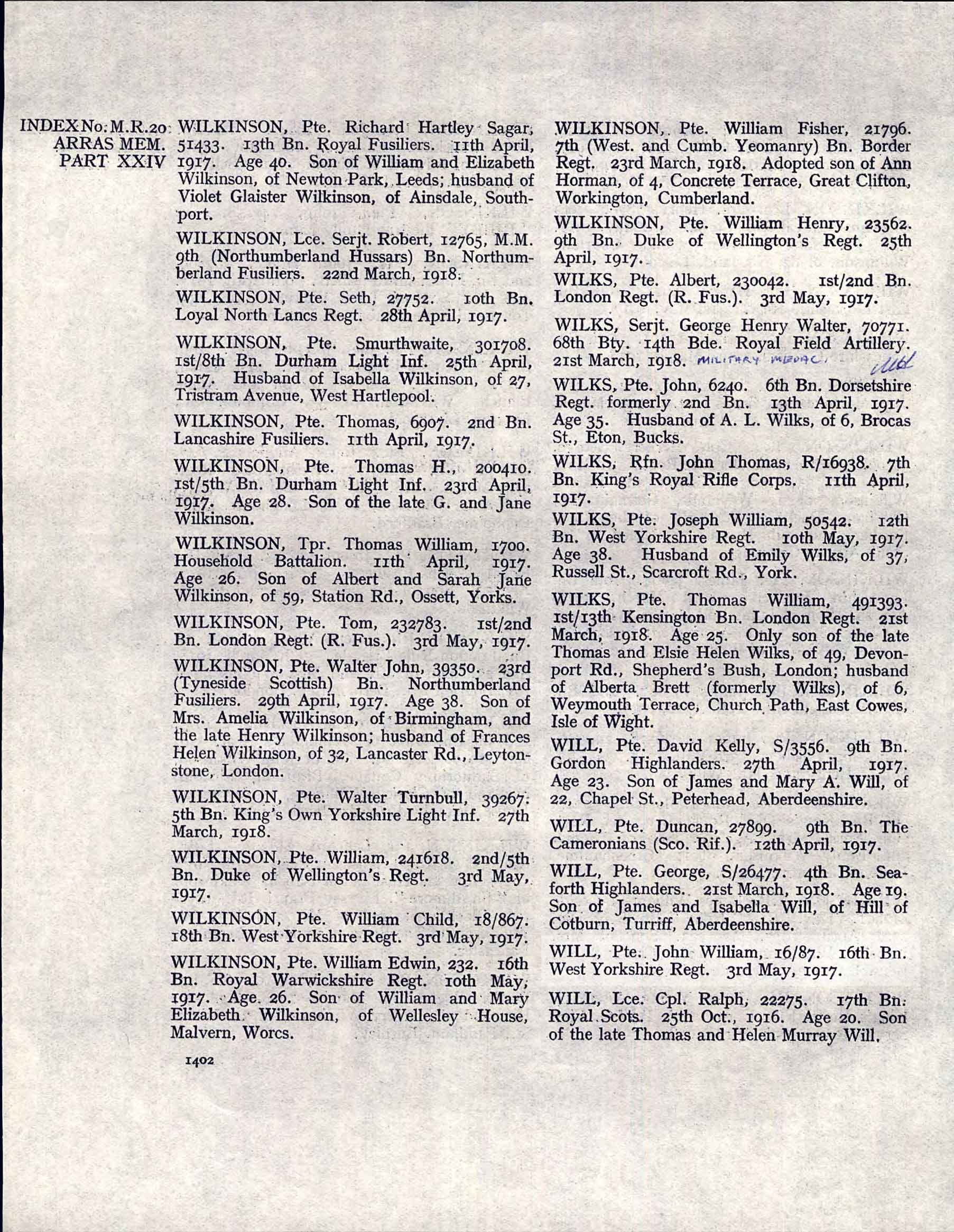
Private J W Will is commemorated on the Arras Memorial in the centre of Arras near the Citadel.
His name appears on the Panel List in Bay 4, column 142. The usual reason for inscribing a soldier’s name on a list rather than
giving them a headstone was that the remains were never found, or never recovered, or could not be identified at the time.
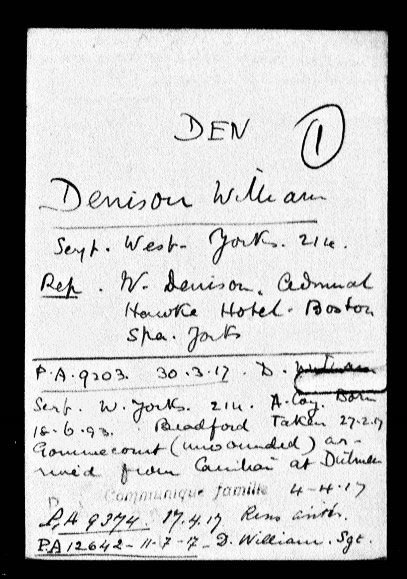
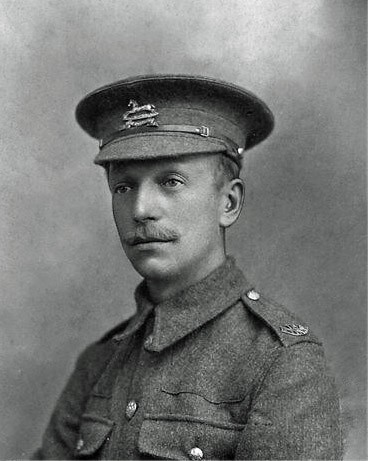
Sergeant William Denison's story
Pte Jack Will and Sgt William Denison were both in the 16th Battalion and may have been acquainted,
though there is no evidence that they were.
On the morning of 27th February 1917 'A' Company was involved in an attack against the Germans
in Rossignol Wood (15km SW of Arras). The Wood was much more heavily defended by machine guns than expected and the attack was unsuccessful.
4 officers and 157 other ranks were killed or wounded and 66 other ranks were unaccounted for.
A Court of Inquiry was held on 15th March to determine why certain NCOs and men went missing after the action.
It heard statements from 8 witnesses.
Major Humfrey Hayes Kennedy said: “About 6.30am I saw a party of about 10 men … they had their hands up and were
evidently trying to surrender.
At the time this occurred I was not certain whether they were British or German … I did not open fire as I would have done
had I known they were British and thus stopped them. They disappeared from view in a dip in the ground.
The light was not good enough to distinguish.” [if any NCOs were in the party].
2nd Lieutenant Tucker said he saw Sgt Denison and about 15 of the men remaining in his platoon go towards the German
lines with their hands held up, shouting ‘Kamerad’.
Pte Higgins said he twice witnessed men running towards enemy lines without their rifles shouting ‘Kamerad’ and ‘Adolf’.
The witness testimonies were followed by a number of testimonials on behalf of the
missing men and NCOs – many of them glowing.
One, for Sergeant William Dennison, read: “Also one of originals in
'A' Company.
Gained his first stripe in Headquarters Mess. Was made Sergt after the battalion returned from up North.
He appeared to be quite capable of performing his duties and as far as I know was popular and all his platoon
had plenty of confidence in him.”
Another testimonial for Denison, by Capt Parker, the Company Commander, said: “Sergeant
Dennison joined this Battalion at its formation, and I have known him for over a year in France.
Sergt Dennison was a very well educated man, and took a prominent aprt [sic]
in raising concerts for the Battalion.
As a NCO he was good, and full control of his men at all times. I have never been with him actually under heavy fire,
but I was led to believe he was cool.”
2nd Lieutenant J M Barrow said: “I have seen a good deal of Sgt Dennison both in the trenches
and out, although not in my platoon . I have no reason to doubt his courage at any time. He was always cheerful and high
spirited in the trenches, and I do not remember observing any traces of fear in his demeanour.”
RSM A E Oddy said: “In my capacity as Regimental Sgt Major of the above named unit,
I have seen a great deal of Srgt Dennison. As a junior NCO he worked very hard for promotion, and he quickly became a very
capable instructor. Latterly I regarded him as being one of the best NCOs in the Battalion. I have never found it necessary
to complain of anything in his conduct either in or out of the trenches. He was very thorough in carrying out his duties at all times,
and never failed to be a good example to his men. I have never seen anything in his conduct that would suggest fear or nervousness.”
The Enquiry found: "That No.
Sgt 16/214 W Dennison and about 16 men of A company went across and gave themselves up to the Germans.
That Sgt Denison is responsible for the surrender of his party.”
Major General Wanless, the Divisional commander, concluded: “I consider Sgt Denison was responsible
for the surrender of his party.” He added: “I am further of opinion that Maj Kennedy showed lack of judgement in not firing on this party.”
On 29th March the DA & QMG of the Fifth Army issued an order: “During recent fighting a NCO and 15 men
of a Battalion which was heavily engaged deserted to the enemy. These men were seen crossing over to the enemy with their hands
up and without arms, but were not fired on by our troops. It should be made known to all ranks that if men are seen crossing
over to the enemy they should be fired on at once, and that men who surrender without sufficient reason or who desert to the enemy,
will be tried after the war and shot.”
William Denison or Dennison was born in 1893 in Laisterdyke, Bradford into an interesting family.
His mother, Ellen Whitaker, from Bolton (Lancashire), married David Taylor in mid-1880. A daughter, Alice Maud,
was born on 9 October that year. Another daughter, Polly, was born on 22 September 1886.
By April 1891, the pair had separated and were living apart – David with his parents
in Barkerend, Ellen with her widowed
mother Rachael Nuttall / Whittaker / Wilkinson in Wellington St, Laisterdyke.
Rachael was, correctly, listed in the census as Ellen’s mother.
But she was also shown as the mother of Polly and Alice Maud, her grandchildren.
One imagines that in order to avoid the stigma of a wife and her children living with no husband in sight,
everyone had to be classed as a child of the head of the household, no matter how improbable.
Ellen Taylor’s third child, William, was born in Wellington St on 18 June 1893. He was given Dennison as his middle name.
This suggests two things: that the true father’s surname was Dennison; and that Ellen persuaded the Registrar
to issue a
birth certificate showing her husband David Taylor as the father.
Another son, Morris Taylor, was born in 1895. He was also a soldier during WW1.
David Taylor, who lived in Barkerend, died of TB on 18 April 1896 aged 40. His brother, rather than his estranged wife, was the Informant.
His widow, Ellen Whitaker / Taylor, married William Denison, the father of her son, in Bradford in
the autumn of 1897.
William Denison snr was born in Idle in 1857, the son of Hudson Denison and Sarah Kaye. He became a police constable and was
probably a sergeant by the time he married Ellen Taylor.
His disciplinary record as PC98 shows he was sometimes late on duty and one incident of being caught in a pub whilst in uniform.
But by the 1911 census, he had become a grocer with his own shop: his son William was an assistant there.
The shop, in Wootton Street, sold beer: on 17 July 1907, he obtained an Alehouse Licence, holding it until 1915.
By 1917, his son’s POW record showed him in Boston Spa at The Admiral Hawke Inn.
Alehouse Licences issued on 10 February 1916 and 7 February 1918 confirm this.
By 1921, William Denison snr was back in Bradford as a police pensioner. He died in 1936 or 1937.
Ellen Whitaker / Taylor / Denison may have died in 1932.
With his low regimental number (214), William Denison jnr would have enlisted in the Bradford PALS in 1914.
After his surrender to the Germans in 1917, he was taken to Cambrai then to a POW camp at Dülmen, near Münster.
He probably had to work in the forest felling trees - prisoners at Dülmen were expected to work.
Although the British Army stopped actively looking for deserters after the War, there was still a potential for prosecution
(and execution) if they were caught. Nonetheless, William seems to have accepted the risk and returned to
England, where he was posted to the Class Z Reserve (on 21 March 1919).
There is nothing in William’s scant record to suggest that he was given an amnesty in return, perhaps, for a confession.
His status as a deserter did not result in the forfeiture of his medals: his entitlement to the Star medal (as a Lance Corporal)
was approved on 20 September 1919. His entitlement to the Victory and British medals (as a Sergeant)
was approved on 20 January 1920.
He married Annie Evelyn Pickles on 3 September 1919 at Bolton Church, Bradford. His father William snr was,
curiously, described as a Gentleman. Their daughter Irene was born in 1920. By 1921 he was employed as a commercial
traveller for Sanitas (which made disinfectant).
By 1928 the family had moved to Harborne, Birmingham and occupied an expensive-looking house in Knightlow Road by 1930.
By 1938 they had a newsagent's and tobacconist's shop at 5 West Heath Road in Northfield.
Unfortunately, William was ill by 1939, being a patient at the Selly Oak Infirmary, which was used as a home for
the chronically sick. He was a traveller for a tobacco company. He died at home in 1943 aged 49 and was buried
at Northfield PC on 15 April. Images
Sources * War Diary of 16th Bn West Yorkshire Regiment - WO-95-2362-1_01 –
available at National Archives.gov.uk * Prisoners of the First World War (Red Cross) – grandeguerre.icrc.org/en/File/Search/#/3/2/224/2803/BritishandCommonwealth/Military/denison * Ancestry.co.uk – for military, employment and BMD records, censuses, electoral rolls, etc