James Hamilton
The
earliest confirmed reference is to James, who married Isabella Strachan in early 1775, although no record of the marriage
has been found. He may have been born in Auchenleck in 1747 to John Hamilton
and Kathrin Munsie, though there is no hard evidence to
confirm links either to the place or to the parents.
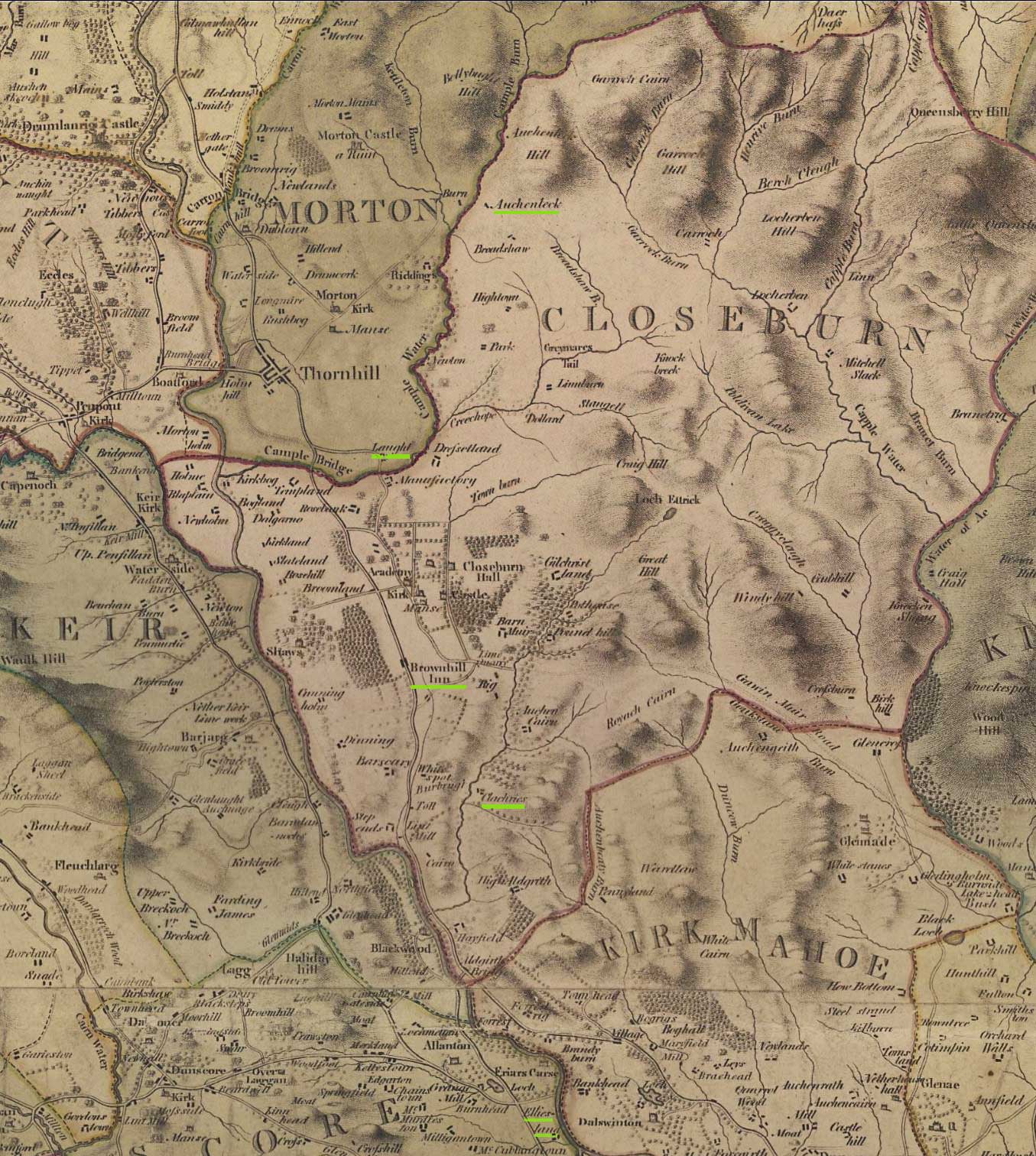
Auchenleck was on the SE flank of its
eponymous hill, roughly where Townhead is today.
John
and Kathrin married in 1737 and had at least 7 children. John was born in 1715
to John Hamilton and Margrat Gibson.
If
these were indeed James Hamilton’s grandparents, then his line can be traced
back to around 1690.
James
and Isabella Strachan had 8
children between 1775 and 1790, six of them boys. The first three - John, Alexander
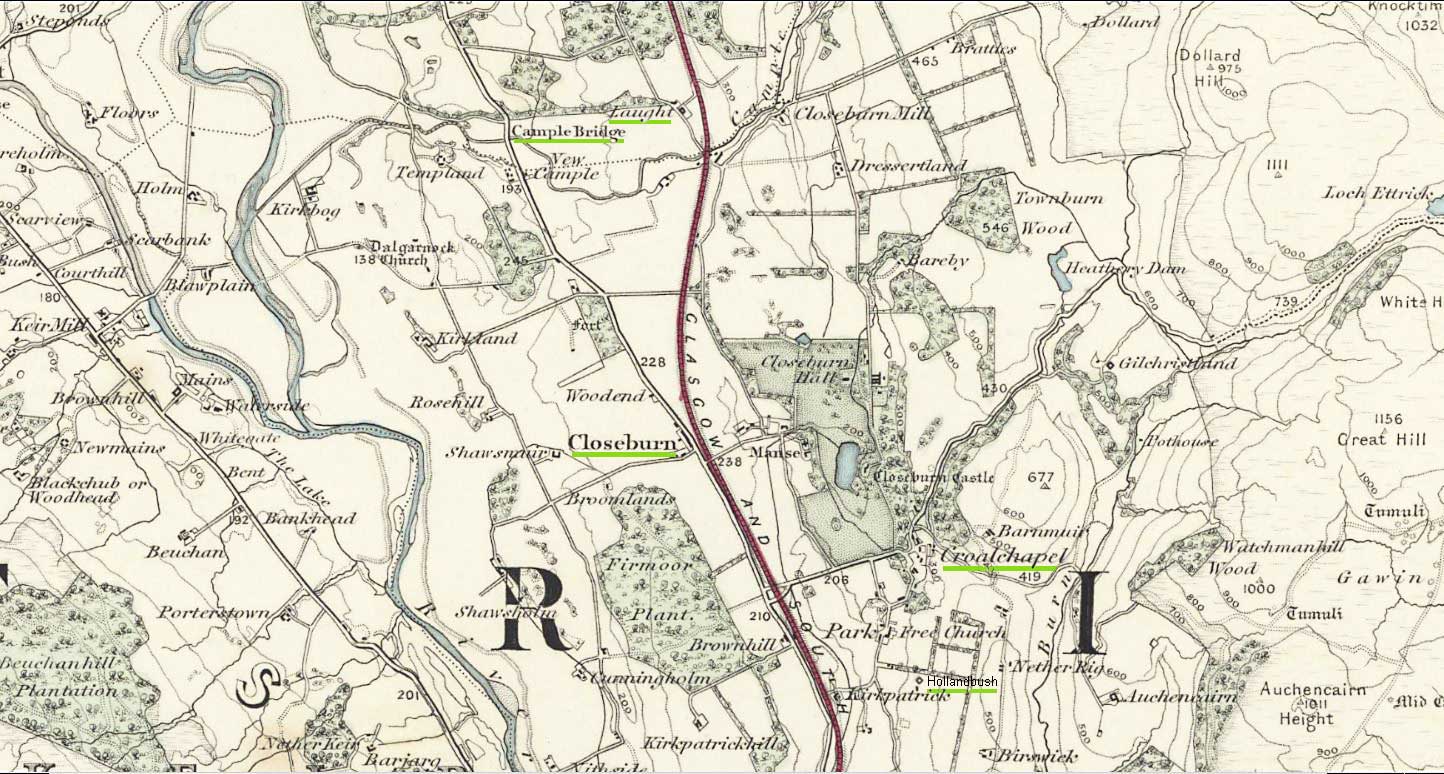
and Margaret - were born at the hamlet of Croalchapel, next to the Closeburn
Limeworks. The remainder - William, Thomas, Catherine, Thomas and Abraham - were
all born at
Laught,
a farm on the north side of the Water of Cample, in Morton Parish.
The
landlord of Croalchapel was listed in 1770 as the Heirs of Thomas Kirkpatrick
and two years later, Sir James Kirkpatrick opened the first of three lime
quarries there. However, by 1780 he was bankrupt and James Hamilton at Croal
Chapel was listed among his many creditors, being owed £50. It is not known how
this rather large debt originated or whether it was redeemed. It may be that
according to custom, James was able to live for a time rent-free on the
Croalchapel holding.
James
and Isobel, together with their son, John, are named in a Testament dated 23
January 1793. This document is an inventory of James’s assets and debts,
compiled after his untimely death on 23 September 1791. He had only just become
a tenant at
Clauchrie,
a large holding in Closeburn Parish containing several farms.
In the same year, a poet called Robert Burns was selling off the
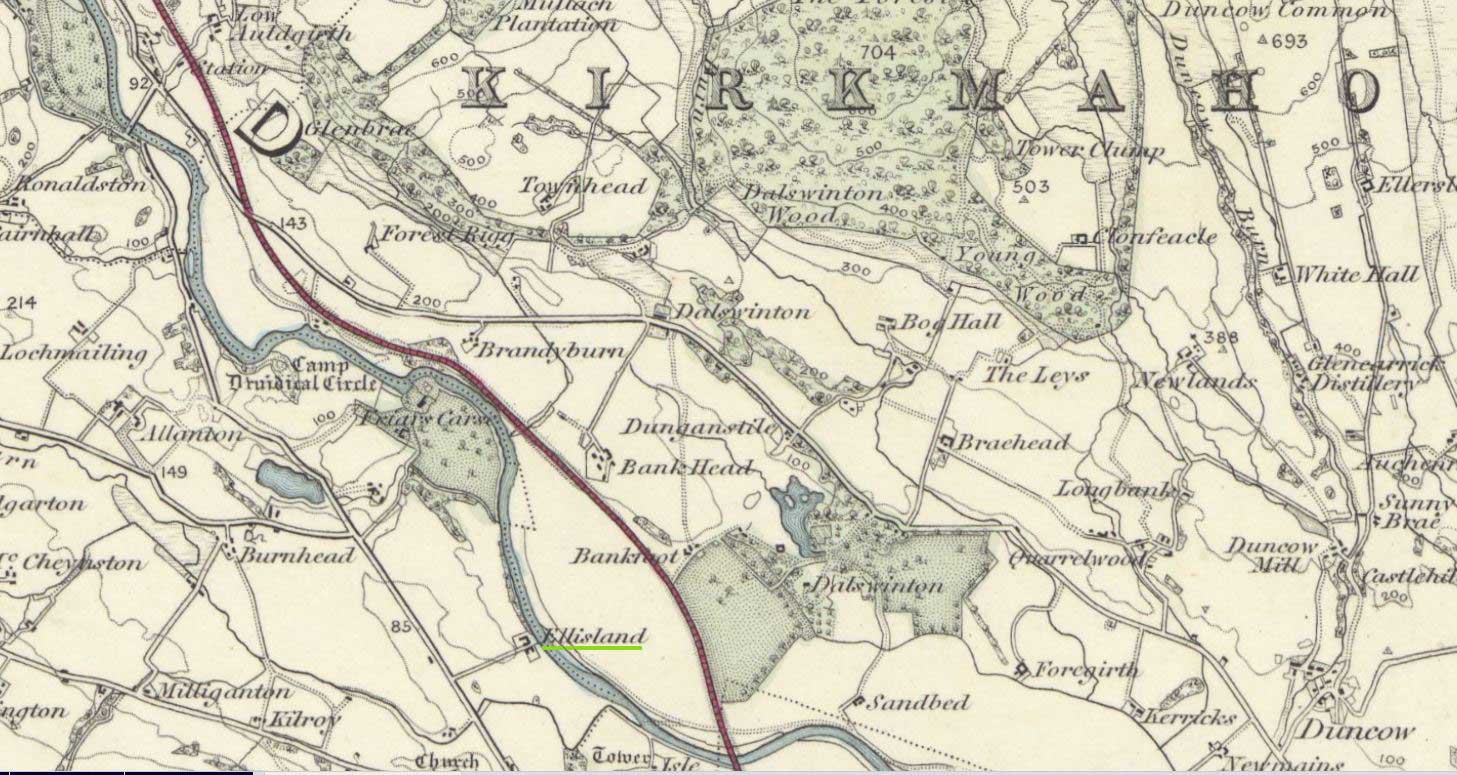
farm stock, crops and implements he owned at Ellisland, the poor farm he rented
in Nithsdale.
Ellisland
is only 4 miles from Clauchrie on the west bank of the
Nith. During his 3 years there Burns would have visited Closeburn and Morton on
Excise business (he was also the local exciseman), to meet friends and to exchange
information with the local farmers. He might well have supped with them at the
Brownhill Inn on the main road to Closeburn. It is just conceivable that he and
James Hamilton met there and shared a dram.
There
were three farms at Clauchrie, each worth around £50 pa (in 1770). The Testament
of 1793 does not say which of the three James worked, but it seems to have included
at least 35 acres of arable land. His total debt was a substantial £76 7s 1½d, being rents, interest
and expenses owed to the proprietor, William Copland. By contrast, Robert Burns
contracted to pay £50 for the first 3 years of his tenancy of Ellisland. James Hamilton's
debt was to be paid by selling the crops in the corn fields. The fields were
measured and the value of each crop estimated. The crops were then sold to
various bidders, including the proprietor and also, surprisingly, to Mrs
Hamilton herself - she purchased around 3½ acres’ worth costing some £13 in 4
separate lots. Where Isabella found the wherewithal to purchase her late
husband’s crops is not known. She lived to the grand age of 87, dying at Cample
Bridge in 1838.
James Hamilton’s children
John was christened at Croalchapel in
1775 but nothing of any certainty is known about him.
Alexander
was born two years later and probably married Mary Shankland who bore him 6
children between 1804 and 1816.
James,
his second-born, died in 1807 and is commemorated on a headstone in Durisdeer
Churchyard, along with his mother and father.
Margaret,
born in 1779, may have had an affair with a Thomas Brown, being called to
account before the Kirk Session in 1802. “She was rebuked for his (sic) sin and
debarred from Church Privileges till she shall have made satisfaction according
to the Rules Of the Church”.
The
fourth child, William, was baptised in 1781 in Laught. There is circumstantial
evidence to indicate that he married Margaret, the 15 year-old daughter of
William Fraser of Park around 1801 and had a son, William, the following year.
Margaret is recorded as dying in April 1802, possibly in childbirth. It is not
clear who looked after the young William but, by 1830, he had married and
settled in Lochmaben, where he managed to purchase a small plot of land at
Gilmoorpark. He died there in 1860, just two years before his father.
Thomas,
the fifth of James Hamilton’s children, was born in 1782 and probably died in
infancy.
Catherine,
the sixth child, was born in 1785 at Laught. She was an Agricultural Labourer
and House Servant who seems never to have married. In 1841 and 1851 she was
living with her brother James. She died in 1857 at Cample Bridge and was buried
in Durisdeer Churchyard.
Thomas,
born a year later, has left no trace.
James
is the only child for whom there are no birth records. At the time of the 1851
Census, he was aged 63, giving a birth date of 1787 or 1788. He married Jane
Waugh, a native of Closeburn, around 1815. They had at least six children: John
(b 1815), Isabella (b 1817), James (b 1819), Jane (b 1824), Margaret (b 1825) and
Jannet (b 1827).
Jane
Waugh died in 1827, possibly in the process of giving birth.
A
year later, James married Margaret Murdoch in Sanquar. When Margaret died in
1855, the only child to be listed on her death register entry was William, who
was born around 1830 and died in infancy.
By
1841 James was a Farmer at
Cample Bridge,
just west of the A76, near the crossing of the River Cample. The farm has an interesting history:
Elspeth Buchan, the founder of a fanatical religious sect known as the Buchanites built
a cottage on the farm and lived there with her followers between 1784 and 1787.
James
died in November 1851 and was buried in Durisdeer churchyard. His eldest
surviving son, James, took over the Cample Bridge tenancy.
Abraham,
the last of James’s and Isabella’s children, survived for a little over a year
after his birth in 1790. He appears on the same page of the Closeburn Parish Death
Register as his father.
William Hamilton
William
(b 1781) seems to have married Mary Alexander after his first wife Margaret
Fraser died.
Their
first child, Isabella, was born in 1806. She married Walter Little, a Farmer from
the Parish of Hutton & Corrie, around 1831. The Littles had 5 children: John (b 1832),
James (b 1834), Mary (b 1838), William (b 1843) and Mary (dob not known), all of whom were
listed on Isabella's death certificate. Walter died before 1851, in which year Isabella was
described as a Widow. She emigrated to Melbourne on the Champion of the Seas in 1861, accompanied
by her firstborn child, John Little. Isabella died in 1895 at 25 Victoria Parade, Fitzroy.
The Informant was stated to be her grandson James Little, who lived at 32 Fitzroy Street.
James could have been John's son, possibly an illegitimate one - there is no evidence of John ever marrying.
When John died in 1900 of heart failure, he was a Grocer who owned premises at 32 Fitzroy Street. In his hastily drawn up Will
he stated that his brother James, who had died in Dumfries in 1895, was deceased and that the balance of his
estate should pass to James's children.
James had eight known children, five of whom were probably alive in the 1900s, living in Scotland and New Zealand.
They were unlikely to have received anything from their uncle's estate.
Nine
more children followed, 8 of them boys. During the next six or seven years, the
family moved from farm to farm, though always on the Closeburn estate of Sir
Stuart Mentieth.
By
the time James, their second child, died in 1813, the family had taken up the
tenancy of a small farm at Park, called
Hollandbush.
The extent of the farm is
listed as 25 Scotch acres in 1845, although the 1851 Census gives it as 42
acres. The Census also shows William as the head of an extended family
comprising his son Alexander, with his daughter-in-law Jane and four
grandchildren. His bachelor son, Charles, was also there. Ten years later, the
farm had diminished to only 23 acres.
William
died in 1862, aged 82. He left no Will, but his estate was valued at £81 4s 6d.
He and his wife, Mary Alexander, are commemorated on one side of a headstone in
Closeburn Churchyard, along with seven of their children - James (b 1807), John (b 1809), Mary (b 1811),
James (b 1813), Robert (b 1819) Grizel (b 1821), and Thomas (b 1825). Sadly,
the last six all died of TB before the age of 30. On the other side of the
headstone - the later Hamiltons were evidently not inclined to waste space -
his daughter Isabella is noted, having died in Melbourne at the age of 89. Also
inscribed are the names of Charles (b
1815) and Alexander (b 1817),
the only two sons to survive into old age.
Charles (b
1815) lived with his brother at Hollandbush for most of his
life and worked on the farm until the 1860s. In 1850 a railway line had been
built through Nithsdale and Charles
established himself as the Coal Agent at the station for the next 25 years or
so. There is still a firm of coal merchants near the old station, called
Hamilton & Hall. He died in 1893, leaving no Will. His estate was valued at
£87 11s 10d.
Alexander Hamilton
When
Alexander (b 1817) married
Jane Jackson at Gatelawbridge in 1842, he described himself, perhaps
with an eye to impressing his new wife’s family, as a Farmer. But by 1851 he
was described as a Farm Servant on the farm run by William, his father. By 1861 he had become a Ploughman. He would
not have been able to take over the farm until William’s death in 1862, though he probably held it until his wife
Jane died in 1898. Approaching his 80th year, he then moved to
Helensburgh to be with his daughters Elizabeth
and Jane. He died there in 1902,
aged 84. The farm at Hollandbush was taken over by his son-in-law, Joseph Brown.
Alexander and Jane had eight
children, half of them girls.
Alexander Hamilton’s
children
Mary was born in 1842 and
worked as a Dairymaid on the farm before marriage to Joseph Brown in 1864. The
couple moved to Winscales Farm, near Egremont in Cumberland and had 5 children
before Mary died around 1875. Although
it was illegal under the Marriage Act of 1835
for a man to marry his dead wife’s sister, Joseph did manage to marry his
sister-in-law Ann (b 1851) in Whitehaven
in 1877, producing a further 5 children. The couple moved back to Dumfriesshire
and Joseph eventually took over the farm at Hollandbush.
William,
born in 1849, married Margaret Dick in 1887. He was a Hammerman at the docks.
There were probably no children. Of James, born in 1852, little is known.
Elizabeth,
born in 1859, married John Barr, a Gardener, and went to live in Helensburgh,
dying there in 1936.
Robert,
born in 1861, married Mary Halliday and remained in Closeburn with his four
children. He took over the Coal Agency business when his Uncle Charles died in
1893.
Jane,
born last, in 1865, married James Burgess and followed her sister to
Helensburgh, where she died in 1913.
Thomas Hamilton
Thomas
was born in 1846 at Hollandbush. Being the first born son, the farm was his to
inherit, but he never wanted to become a farmer. Instead, on a winter’s day at
the end of 1867, he was to be found marrying Ann Eliza Cooper at St John's Parish Church in Manchester. His wife was the daughter of an official in the Parish Office, a man
who had crossed the Pennines from his birthplace near Harrogate and married a
Manchester woman. His ancestry on his mother's side can be traced back to the 17th Century through the
Skaife and Cooper families.
Alexander,
Thomas’s first child, was born in 1869 at Hollandbush, but that was the last
time Thomas ever lived in Dumfriesshire. Two years later, he was working as a
Boatman on the Paisley Canal. He had a variety of labouring jobs until Ann
died, of a stroke, in 1883. At that time he was a Bread Vanman, but a year
later had become a Drapery Traveller.
Ann’s
sister, Hannah Skaife Cooper, had already left Manchester to
become a Telegraph Clerk at the Glasgow Post Office. It took Thomas Hamilton
only 6 months after his wife’s death to persuade Hannah to move in and look
after her sister’s four boys. And she bore him 6 more children, all of them boys.
Hannah had taken the Hamilton surname by the time of the 1891 Census, but there is no evidence
that the couple ever married. Either they did not think it worthwhile, or the Scottish Marriage
Act of 1567, which prohibited marriage with a deceased wife's sister, put them off.
It is likely that none of the boys were aware of their illegitimate status.
It
had always been supposed that during this second phase of his life Thomas
worked for the Scottish Cooperative Society’s Drapery Department. However, at
various times up to 1912, he was described as a Jeweller and as an Insurance
Agent. In the early 1900s he seems to have established his own businesses, as a
Shirt Manufacturer (in 1901) and as an Underclothing Manufacturer (in 1903); they
may have been good-going operations - the flat in Bedford Lane had 8 rooms and Thomas
was listed in the 1901 Census as an Employer, working at home.
Thomas
died on 10 February 1913, aged 66.
Thomas Hamilton’s children
Thomas
had 4 children by Ann Cooper and 6 by her sister Hannah. Remarkably, they were
all boys.
Alexander, born in Closeburn in 1869,
married Mary Johnston in 1893 and had 4 children. He worked as a Warehouseman in Millport, where he died in 1957, aged 88.
His firstborn, David (b 1893) was a Draughtsman in Barrow-in-Furness and Widnes, where he died in 1974.
He married Ethel Miller in 1921 and had 2 children.
Neil (b 1895) emigrated to New York in 1923. He married a Glasgow girl, Minnie Love, in 1925 and had a daughter, Elizabeth.
They moved to Los Angeles, where he was a Checker in a creamery. He died in 1981.
Thomas Cooper (b 1899) was a Commercial Traveller who married Edith Anderson in 1928. They lived in Eaglesham and had 2 children. He died in 1970.
Annie Cooper (b 1904) lived in Millport with her husband George Watt, whom she married in 1931. She died in 1990.
There were 2 children: Annie (1932-2019) and Douglas.
Thomas Cooper, born in Rutherglen in 1872,
married Robina Tough in 1899 and had 5 children.
Originally a blacksmith, Tommy opened a tobacconist cum snooker hall at Paisley Road Toll. After Robina died in 1916,
he married Catherine Urquhart in 1918. He died in 1923 in Edinburgh, although he was still living in Paisley Road, Glasgow.
His firstborn child, Robert Tough Hamilton (b 1900), was a highways engineer who married Daisy McKay in 1934 and moved to
Kings Lynn, then to Darlington. His only child, Ian Hamilton (1938-2001), went to Oxford University and became a poet, literary critic and influential publisher of literary works. He was married to the Egypian novelist Ahdaf Soueif.
The other four children were girls. Thomas had wanted boys, so he gave some of them variations on boy's names:
Annie Cooper (b 1902) married Malcolm McLean in 1922 and had one daughter. She died of TB in Govan in 1926.
Hectorina (b 1904) married a Police Constable called John Sinclair in 1937 and had 2 children. John died, possibly in 1947.
Hectorina married Duncan McArtney in 1954. She died in Giffnock in 1982.
Robina (b 1906) married a Steel Erector called Alexander Gray in 1942. Nothing is known about any children. She died in Cardonald in 1986.
Thomasina (b 1912) married James Auld in 1929. He died in 1941 and she married Richard van Hegan Allan in 1949.
Nothing is known about any children. She died in Kirkliston in 2012.
Joseph Ernest Greaves was born in 1878 in Nitshill. Greaves was the name of his Aunt Polly's first husband.
Before marrying Martha Lustie in 1904 he worked for his father as a Shirt Ironer. The couple lived in Bothwell and in Armadale,
where he was a Railway Brakesman. He was probably at work in 1914 when he had a fatal accident.
Before marrying Joseph, Martha had an illegitimate daughter, Christina (b 1899), who was most likely brought up by her grandparents.
Of the couple's children, nothing is known of Thomas (b 1904).
Mary (b 1907) lived with her mother and stepfather in Swindon and had an illegitimate child, Kenneth Joseph (1930-1991).
Annie Cooper (b 1911) moved to London on marriage to Charles Harrison, who worked in foreign embassies. She died in Repton in 1987.
Joseph's namesake, Joseph Ernest Greaves Hamilton, was born in 1913, married Grace Wiltshire in Swindon in 1940 and had 2 children.
A Butcher, he died in Witney, Oxfordshire, in 2004.
James (b 1881) was a Miner who could turn his hand to poetry. He married Sarah Bell in 1904 and had 3 children. He died in 1942.
His firstborn, Isabella (b 1904), married Robert Frizzel in 1928 and had 2 children. She died in East Kilbride in 1928.
Thomas (b 1906) died in Blantyre in 1975.
John (b 1907) married Roseann Marshall in 1937 and emigrated to Western Australia, where he is thought to have had 3 children.
He died in 1974.
William Francis
was born to Thomas’s second ‘wife’, Hannah, in August 1884 at 20 Rutland
Crescent. Francis was the name of his great grandfather from Yorkshire. He went
into the Coop as a Grocer’s Assistant, but soon - by 1910 - became a manager in
the Grocery Department, the youngest in the Coop’s history.
Also
working there, as a cash girl - she used to receive the customers’ cash in a
tube on a string - was Jane McAinsh Stewart.
They married in 1914 at the Wheatsheaf Rooms at Paisley Road Toll - it was a
large wedding with at least 50 guests - and spent the first years of married
life in a small flat at 29 Carfin Street, Govanhill. William was a teetotaller
- Jane would not have married him otherwise. But he was a smoker and this led
to the bronchitis that afflicted him in his later years. The family moved up
the social scale a little when they moved from Govan / Gorbals to
Pollokshields, occupying a room-and-kitchen there. This was just round the
corner from Jane’s family home in upmarket St Andrews Road and she must have
felt that she had come back to her rightful place in the world. William became
a local pillar of the community - rising to Right Worshipful Master of a Masonic
Lodge. He was called up in 1916 and received the leg injury that gave him a
permanent limp. Returning from the War in his thirties, he was turned down for
promotion to Area Manager. Thereafter, he became bitter and withdrawn, an
unsociable man who retreated to his plot - allotment - whenever he could.
He
died in 1960 at the age of 74.
Arthur
was born in 1886. Starting off as a Message Boy, he was a Grocer’s Assistant
when he married Catherine Cumming in 1912. Kate was a Catholic, while he was
Presbyterian and the pair of them often argued because he wanted his children
to go to a Presbyterian rather than a Catholic school, even though it was the
custom for girls to go to the school of the mother's religion. Arthur
eventually became a Grocer, owning two shops, although when he died in 1951, he
was described as a Dairyman. He was wealthy enough to own a car, a vehicle
chiefly remembered for its rattles and leaks.
There were 2 daughters:
Margaret (Dolly) was born in 1915, married a Salesman called George Walter in 1938 and moved to New Jersey, where she died in 1991.
Veronica (b 1917) probably never married, though she may have had a child in America.
A Sales Assistant, she lived with her sister in Newark, New Jersey, where she died in 1979.
Charles was born in 1889 and followed his brother into the grocery business - he was a Grocery Salesman when his second child
Hazel was born in 1922. He married a Londoner, Eva Moore, in Harlesden, Middlesex, in 1920, but set up home back in Glasgow.
He was said to have owned a Tobacconist's shop, though it may have been a sideline: when his son Wilson was born,
he was described as a Newsagent. During and after the Second War he was a Police Officer in the War Dept and, until his death in 1957,
an Ordnance Work Pump Attendant.
He had 3 children:
Darrell (b 1920) joined the army and was stationed in Belgium, where he married Maria Vandegoor in 1945. He died in Antwerp in 1974.
Hazel (b 1922) married Alexander Maloney in 1945 and died in Rothesay in 2000.
Wilson Marshal Thomas (b 1929) married Andrewina Downs in 1951 and died in Livingston in 2009.
Robert
was born in 1890 and nothing is known about him after the 1901 census.
Benjamin was born in 1892 and followed his father into the drapery business, starting off as a Warehouseman.
He married a French Polisher called Sarah Fyfe in 1912. After the War he worked in the mines, spending the rest of his life in grimy Blantyre.
Because of this, he was considered (by his sister-in-law Jane) to be rather beneath the Hamiltons of posh Pollokshields.
His niece Elizabeth said the family belonged to the Wee Frees and gave all six of their children biblical names:
Hannah, Sara, Rebecca, Daniel, David and Jacob. She described him as broad and squat, with pronounced bow legs, a ruddy face,
eyes black as treacle under thick black tufts and grey-black hair which stood up like wires over his scalp.
"He had a slow rich voice which flowed over you like warm water."
He died in 1966 of heart failure and pneumoconiosis.
Benjamin and Sarah probably had 8 children:
Rebecca (b 1915) married Neil MacPherson in 1935 and had 2 children - Benjamin and Sarah. She died in 1988 in Bellshill.
Matthew (b 1917) died in Prestwick in 1989.
Hannah Skaife (b 1919) married Douglas Rattray in 1942 and died in 2004.
Benjamin (b 1920) was a Coal Machineman, like his father. He married Margaret Clarkson in 1942 and had at least one child - Lindsay (b 1949). He died in 1988.
Sarah (b 1923) married James Tennant in 1944 and died in 1975.
David (b 1924) died in Glasgow in 2004.
Charlotte (b 1925) died in Bellshill in 1979.
Agnes was born in 1929 and died the following year.
Frederick was the last born, in 1896. He began his working life as a Railway Porter and was just old enough to be called up,
as a Private in the Royal Scots. He is reputed to have come back from the War with syphilis.
Before the War ended, he married Helen Baskerville in Glasgow in 1917. He followed his brother to Blantyre, becoming a Miner.
He had 3 children:
Hannah Skaife Cooper was born in 1918 but only survived until 1936.
Sarah (b 1920) was a Fishmonger's Assistant who married Alexander Paterson in 1943. She did her war service in the WAAF. She died in Glasgow in 2000.
Thomas (b 1925) was a Wood Machinist who married Barbara Hobbin in 1949 and died in Newton Mearns in 1996.
Notes on the History of Closeburn and the Early Hamiltons
Names
The name Closeburn is thought to
derive from the 12th century Kylosbern, meaning the 'church of Osbern', an Irish saint. In 1232 Ewen Kirkpatrick was confirmed as the possessor of land at
Closeburn by Alexander II in recognition of his role in policing the strategic
valley of the River Nith. The Kirkpatrick family
ruled the district for over 500 years until 1783, when bankruptcy forced the
sale of the estate to Rev James Stuart Menteath.
The origin of the Hamilton surname is uncertain,
but most authorities consider it to be based on a place name, derived from hamell, meaning
either a treeless hill or a home and dun,
meaning either a hill or an enclosed, fortified place. There were a number of places in England called Hamelton, Hambleton or similar
and the founder of the aristocratic line of Scottish Hamiltons is supposed to
have taken his surname from one of these. A Norman baron called Walter FitzGilbert de Hameldone owned
property near Paisley in Renfrewshire in 1294. In return for supporting Robert the Bruce
he was granted further lands in Lothian and Lanarkshire, including a burgh
called Cadzow, which was renamed Hamilton in 1445, after its
owner.
It is quite possible
that the town was the origin of the Scottish Hamiltons. If this is the case, it would mean that not
all families named Hamilton living in a
particular area would necessarily be related to one another. Nor would they be related to the ancient
Norman family of that name. And the
reason for this lies in the way ordinary Lowland Scots acquired their
surnames. Tax collectors working for the
State, the Church or the barons needed an effective means of identifying those
who were liable for taxation. Looking
for John’s son or Alexander the weaver was no longer satisfactory. People were obliged to append surnames to
their given names. A proprietor would be likely to take
the name of his estate and tenants might in turn assume, or be given, the name
of their landlord. Accordingly, many Scottish Hamiltons will have derived
their name from the town, without being in any way related.
Early
Genealogy
The earliest Hamiltons so far found were
three registered for the 1684 Privy Council deposition in Durisdeer parish: John
at Colinie, William at Auchinsell
and Grissel, married to John Gillies,
at Drumcruill. The last two farms were just across the Carron Water from Morton parish, while Colinie
was much further up the valley.
A William Hamilton,
possibly the Auchinsell man, was found at Old Castle in Morton in the 1691
Hearth Tax list. He was married to Janet
Hastie and produced a girl and a boy in 1693 and
1696. He may have had a sister, Janet,
who was married to William Hair.
There were two other women
registered in Morton parish in 1684: Agnes Hamilton, the probable spouse of
William Ferguson, at Kirkland, and the unnamed
spouse of Alexander Brown at Ears (East?) Morton. These two were listed as Recusants - likely
Covenanters - and are notable because they are stated, rather cryptically, as
being “with the family of Laught”, where a Hamilton family lived in the
18th Century.
The Old Parish Records
also show two Hamilton wives who were not listed in the 1684 and 1691 records,
suggesting they may have come to live in the parish of Morton after 1691, when
their reverend husbands took up appointments there: Helen Hamilton is listed as the Relict of Mr
Patrick Flint who would have died in late 1691 or early 1692, while Christian
Hamilton probably arrived early in 1692 with the replacement minister, her
husband, Rev John Pasley.
The boy Hamilton born in 1696 (referred
to above) may have been called John and may have married Margaret Gibson in
1715, starting a line of Hamiltons based in Auchenleck,
in Closeburn parish.
A probable offshoot of
this family was later to occupy Park and Cairn in the south.
The main Hamilton line, which occupied
Laught, Clauchrie, Croalchapel and Hollandbush, is also likely to have
originated in Auchenleck but, as yet, there is only circumstantial evidence for this.
Closeburn economic
history notes
It is not known for
certain where our Hamiltons lived in the first 75 years of the 18th
Century but they were likely to be found in Auchenleck, in the north of Closeburn
parish, and in Laught, just across the Water of Cample in Morton parish.
These were tough years for anyone
trying to make a living from the land - prices were stagnant and sometimes
fell; soils, arable and pastoral, were exhausted from overuse; tenants had no
security and little incentive to improve their husbandry; holdings were
generally small and inefficient; implements were rudimentary; frequent bad
weather events disrupted agriculture and caused temporary famines: for example,
the summer of 1781 was cold & dry - grass & corn failed to grow
properly - the following year the season was 'cold & backward' such that
unripened corn was buried by the snow that fell in October.
Living conditions were primitive -
in many places, houses were described as hovels, built of stones and mud,
thatched with sods or straw, with damp earthen floors, having low doors and
windows without glass.
It was not unusual for several
households to live under one roof, sometimes with the cattle occupying one end
of the building. In a typical ‘but and ben’ longhouse, the tenant farmer would
occupy the ‘but’ or living room while his servants would sleep in the ‘ben’. Ploughmen,
labourers and other farm servants often slept in the farm kitchen where food
was prepared and eaten; butter and cheese making and other processes also took
place there. Surprisingly, given the moral climate of the time, both male and
female servants would often dress, undress and sleep in the same room,
resulting, according to an official report, “in an amount of “immorality and
illegitimacy”.
Otherwise, female servants might
lodge in the rafters and be exposed to the smoke from the hearth, yet be free
of insect pests and parasites.
The final 25 years of the 18th
Century saw big improvements in the living standards of ordinary folk over
large parts of Scotland. The Rev Andrew Yorstoun, minister for
Closeburn reported in his Statistical Account, written in 1792, that in place
of “dirty croft, and poor outfield crops
of gray oats and small bear … big rich crops of excellent oats, barley, wheat
and pease, potatoes, turnips and sown grasses are almost everywhere to be seen.
The rents of the farms in general are
more than doubled, yet the tenants live incomparably better than when they paid
not half the present rents. Closeburn, from being in great measure a bleak and
barren, has become a pleasant and fertile spot in itself …”.
The reasons for this remarkable
turnaround were largely to do with the agricultural improvements that were
slowly filtering up from England. But their implementation by a conservative
tenantry depended on proprietors who could encourage and facilitate the
adoption of the new methods. In
Closeburn, Sir James Kirkpatrick was both enterprising and enlightened in his
approach. In the words of Mr Yorstoun,
“The lime works of Closeburn [at Croal Chapel] deserve particular notice. By improving the land and exciting a spirit
of industry of the people, they have proved a public blessing to the country,
as well as a source of wealth to the proprietor. The lime rock was discovered many years ago
but was in great measure neglected until Sir James Kirkpatrick, the late
proprietor of Closeburn, took it into his own management. It is just about 20 years since he began to
carry on that work, and from that period the country has been improving with
astonishing rapidity.” To win over his
tenants and their traditional ways, Kirkpatrick handed out the lime, paid for
the carriage and charged just 5/- extra rent for every 80 measures of lime
(enough for an acre of land). “To men of small capital who could not afford to
be at the expense of liming their ground themselves, this scheme was evidently
beneficial.”
Yorstoun reported that from 1755
to 1791, the population had increased by 50% and that “This great increase has
been occasioned by extensive lime works in the parish, the division of farms,
making of roads and other improvements”.
Living standards improved
markedly, despite rents increasing, due in part to wage rates going up and in
part to the creation of new employment. Because
many farmers only had small plots to tend, “during the rest they find abundance
of employment in carting lime from Closeburn, and coals from Sanquar to the limeworks and to the town of Dumfries”.
Wages in the 1770s were around £4
pa for a labouring man kept in the house - a Farm Servant - and half as much
for a woman. By 1792 they had risen to 6
- 8 guineas for a man and up to 4 guineas for a woman.
Concerning housing, the good
reverend had mixed views: “…… there is a great number
of houses lately built in the parish. Some of these indeed, being built by
subtenants at their own expense, are but indifferent;
and it is a little unfortunate that these poorest houses are built along the
great road which passes through the parish. Travellers, from the mean appearance of these
houses, are apt to form an unfavourable opinion of the country. But the principal farmers are generally lodged
pretty comfortably.”
Forty years later, Rev Andrew
Bennett wrote, “Such miserable dwellings [of the 18th Century] have
been succeeded by comfortable and commodious dwelling-houses, generally of two
stories, and in every way fitted for the convenience and accommodation of the
respectable tenantry that inhabit them.”